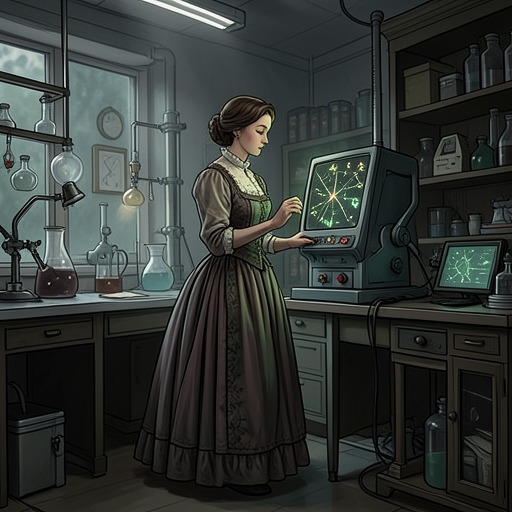
The Siberian tundra
Miss Peregrine's Home of Peculiar ChildrenThe Siberian tundra is the site of the disastrous 1908 experiment in which a renegade faction of peculiars sought immortality by manipulating time. The catastrophe there created the Hollowgasts and turned an attempt to escape death into the origin of a lasting threat to peculiar communities.
The Expedition and Its Aim
Around the turn of the twentieth century, a faction of disaffected peculiars believed they had found a way to pervert time loops. They hoped to reverse aging, attain eternal youth outside loops, and move between past and future without suffering the usual consequences of such travel.
Miss Peregrine opposed the scheme as impossible and warned that it should not be attempted. Her two brothers, whom she describes as technically gifted but lacking judgment, nevertheless asked for her help. They had grown up among the ymbrynes-in-training at Miss Avocet’s academy and knew enough about the art of time manipulation to make their ambitions dangerous.
Despite warnings and threats from the Council, the brothers and several hundred members of the faction—including powerful ymbrynes—went to the Siberian tundra in the summer of 1908. They chose a nameless loop that had been unused for centuries. Their opponents expected them to return within a week, chastened by the limits of nature; instead, the expedition ended in an explosion.
The Explosion and Its Survivors
The blast was powerful enough to rattle windows as far away as the Azores. Those who heard it assumed that everyone at the site had died, and the explosion seemed to be the expedition’s final act.
The participants had survived, but not in the form they intended. Weeks later, attacks on peculiars began, carried out by creatures that could not be seen by ordinary people and were visible only to peculiars such as Jacob Portman. The creatures’ emergence from the crater revealed that the experimenters themselves had become the first Hollowgasts.
The precise cause remained disputed. One theory held that the experiment reversed their aging to a point before their souls had been conceived, leaving them with empty hearts and souls. In this account, they gained a form of immortality, but it was an existence of isolation and unending hunger, not the godlike freedom they had sought. Their appetite for the flesh of their former kin was tied to a possible route to salvation: a Hollowgast that consumed enough peculiars could become a wight.
The Tundra in the Story’s Time System
The expedition’s choice of an ancient, long-unused loop makes the tundra more than a remote setting. A loop confines and repeats a particular day, while its continued stability depends on an entryway being crossed periodically. Without ingress or egress, pressures accumulate and the temporal system can become unstable. The experiment therefore turns on an attempt to exploit the very structures that ymbrynes ordinarily maintain and use to protect peculiar people.
The book later explains that travel between loops can reach loops that have otherwise ceased to exist: by leapfrogging from one loop to another, travelers may gain access to a widening chain of temporal destinations. Against that broader possibility, the 1908 expedition marks a catastrophic boundary. The faction’s desire to command time without being subject to death instead produced creatures trapped in a tormented form of life.
Narrative Significance
The tundra is known chiefly through Miss Peregrine’s retrospective account of the experiment and its aftermath. Its otherwise unnamed, centuries-unused loop gives the disaster an isolated point of origin, while the later attacks show how the consequences spread far beyond the original site.
The experiment’s outcome reverses its stated promise: the pursuit of eternal youth yields neither freedom nor mastery, but a degraded, predatory existence. The tundra thus anchors the story’s explanation of the Hollowgasts and establishes the cost of treating time as a means to escape the limits that govern life and death.